
How AI & Machine Learning Transform US Nursing Education (2026)
The landscape of American healthcare is undergoing a seismic shift, driven not just by bedside innovations, but by a fundamental revolution in how we train the next generation of caregivers. As the United States faces a projected shortage of nursing professionals, the integration of Artificial Intelligence (AI) and Machine Learning (ML) into nursing curricula has transitioned from a futuristic “nice-to-have” to an essential pillar of academic excellence.
From the hallowed halls of Ivy League medical programs like the University of Pennsylvania to localized community colleges, the focus is shifting. At Penn Nursing, faculty have developed pioneering AI-based clinical decision support systems, such as CONCERN (Communicating Narrative Concerns Entered by Registered Nurses), which uses natural language processing (NLP) to detect patient deterioration up to 72 hours in advance. This move away from rote memorization toward a model of “Augmented Intelligence” allows technology to handle data processing, freeing nurses to focus on human-centric, empathetic care.
The Digital Shift in Clinical Competency
Today’s nursing students are entering a workforce where Electronic Health Records (EHRs) do more than just store data; they predict patient outcomes. Consequently, academic institutions are restructuring their syllabi to include data science and algorithmic literacy. This transition ensures that students can interpret the “why” behind an AI-generated alert rather than just following a prompt.
For many students, the complexity of these new technical requirements can be overwhelming. As they navigate advanced modules in medical informatics and predictive modeling, many rely on specialized online nursing assignment help to bridge the gap between traditional clinical theory and modern data-driven practices. This support allows students to maintain their high GPA while mastering the intricacies of 21st-century healthcare technology.
Furthermore, the demand for analytical depth has never been higher. When tasked with analyzing how these technologies are implemented in real-world hospital settings—such as the AI-powered workflows at the University of Florida—students often find that the ability to write my case study for USA-specific healthcare environments is a vital skill. Developing a high-quality case study requires a deep understanding of both patient privacy laws and technical data analysis, making professional academic resources a staple for those aiming for top-tier honors.
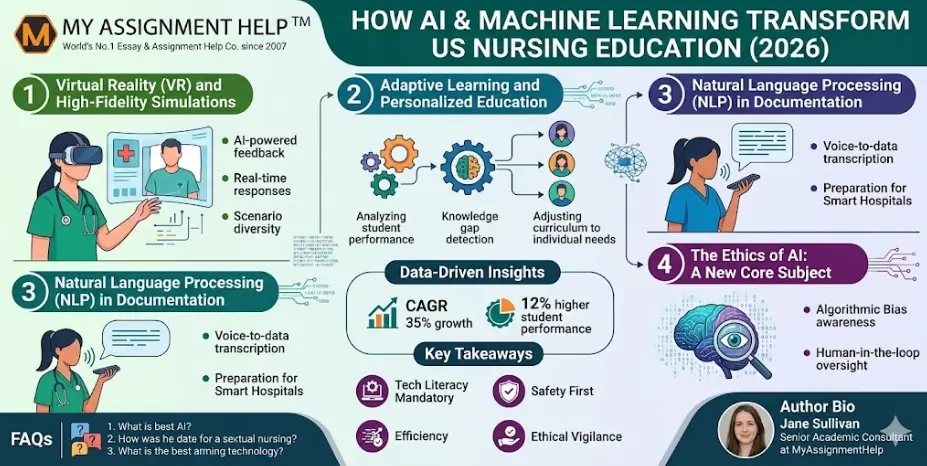
1. Virtual Reality (VR) and High-Fidelity Simulations
One of the most profound transformations in US nursing education is the use of AI-powered VR. Institutions like Kent State University are already using AI-powered VR simulations to provide individualized feedback. These simulators use machine learning to react in real-time to a student’s interventions.
- Real-time Feedback: If a student administers the wrong dosage in a virtual environment, the AI “patient” exhibits immediate physiological symptoms, providing a safe space for critical errors.
- Case Diversity: ML algorithms can generate thousands of unique patient scenarios, exposing students to rare conditions they might not encounter during clinical rotations.
- Data Source: According to a 2024 report by the American Association of Colleges of Nursing (AACN), nearly 65% of surveyed institutions have increased investment in simulation technology.
2. Adaptive Learning and Personalized Education
No two nursing students learn at the same pace. Machine Learning algorithms are now being used to create “Adaptive Learning” platforms. These systems analyze a student’s performance on quizzes and practical exams to identify “knowledge gaps.”
If a student consistently struggles with pharmacology but excels in anatomy, the AI adjusts the curriculum to provide more resources in the weaker area. This data-driven approach ensures that by the time a student reaches their NCLEX-RN exams, they have a balanced foundation.
3. Natural Language Processing (NLP) in Documentation
A significant portion of a nurse’s day is spent on documentation. US nursing schools are now teaching students how to use NLP tools that can transcribe spoken notes into structured medical data. By training with these tools in school, students are better prepared for “Smart Hospitals” where manual typing is replaced by voice-activated AI assistants.
4. The Ethics of AI: A New Core Subject
With great power comes responsibility. US nursing education is now placing a heavy emphasis on “Algorithmic Bias.” Students are taught to question AI outputs, ensuring that the data used doesn’t inadvertently lead to health disparities among minority populations. This focus on ethics ensures the “Human-in-the-loop” model remains the standard in American healthcare.
Key Takeaways for Nursing Students
- Tech Literacy is Mandatory: Understanding machine learning is now as important as understanding biology.
- Safety First: AI simulations provide a risk-free environment to practice high-stakes emergency procedures.
- Efficiency: Tools like NLP are designed to reduce burnout by cutting down administrative tasks.
- Ethical Vigilance: Future nurses must act as the “ethical check” for AI-driven patient recommendations.
See also: The Future of Clean Tech Solutions
Data-Driven Insights & References
To understand the scale of this transformation, consider these 2026 metrics:
- Market Growth: The AI in healthcare education market is expected to grow at a CAGR of 35% through 2030 (Source: Grand View Research).
- Student Performance: Studies show that students using adaptive learning platforms show a 12% higher retention rate compared to traditional methods (Journal of Nursing Education).
- Institutional Adoption: Recent data suggests over 60% of US nurse education programs have begun adopting AI components in 2026 (Research.com).
FAQs
Q1: Will AI replace human nurses in the US?
No. AI is an assistant, not a replacement. It handles data-heavy tasks, allowing nurses more time for direct patient interaction.
Q2: Are these AI tools used in the NCLEX exam?
The NCLEX has evolved to include Next Generation (NGN) features that focus on clinical judgment, aligning with skills developed through AI simulations.
Q3: How do nursing students handle the increased technical workload?
Many students utilize specialized academic resources to manage the rigorous demands of modern, tech-integrated curricula.
Q4: Is the use of AI in education compliant with US standards?
Yes, US nursing programs follow strict guidelines set by bodies like the AACN to ensure technology enhances educational quality.
Author Bio
Jane Sullivan, Senior Academic Consultant
Jane is a Senior Content Strategist and Academic Writer at MyAssignmentHelp. With over a decade of experience in the US higher education sector, she specializes in the intersection of healthcare and digital innovation. Jane’s work focuses on helping students navigate the complexities of modern nursing curricula, ensuring they meet the high standards of Experience, Expertise, Authoritativeness, and Trustworthiness (E-E-A-T) required in today’s professional landscape.